Showing posts with label Science. Show all posts

Thursday, 11 February 2016

Everything about LIGO and the Gravitational Waves


Ligo detector, hanford, gravitational wave, LIGO
LIGO detector at Hanford, Washington. Credit : LIGO Laboratory

"Ladies and gentlemen, we have detected gravitational waves. We did it!". 

Yesterday (11 Feb 2016), physicists at LIGO, officially declared the discovery of gravitational waves. Rumours have been spread months before the declaration and medias were going frenzy. Scientific world was eagerly waiting. Words of the notable physicist, Lawrence Krauss, before the official declaration, "New era in Astronomy and Physics could begin". It is said to be the discovery of the century.  

But why this fuss? Why scientists are going crazy about this? Is it going to change our understanding of the Universe?

Credit : sciencenews.org
First let us know what a gravitational wave is. The concept of gravitational wave was put forth by the renowned scientist, Albert Einstein, through his mind numbing, General Theory of Relativity. According to General Relativity, space and time are aspects of a single measurable reality called spacetime. The objects in space can create warps in the fabric of spacetime. More massive the object, more the warping would be. This curves in the fabric of spacetime is the reason behind the gravity

Moon does not revolve around earth, as earth pulls it, instead it takes the direct path in four dimensional spacetime. 

If the spacetime can be warped like a fabric, then it can be rippled also. It will ripple when there is a sudden movement of massive objects. If an object, big or small, is sitting still or in constant motion, it's gravitation field will be static and there won't be any gravitational wave. But when it moves suddenly (speeding up, slowing down or changing direction), like in an explosion, then its gravitation filed changes and causes the ripples in spacetime. Such ripples in the fabric of spacetime are called as gravitational waves. Earth too gives off gravitational waves, but its extremely weak and faint.
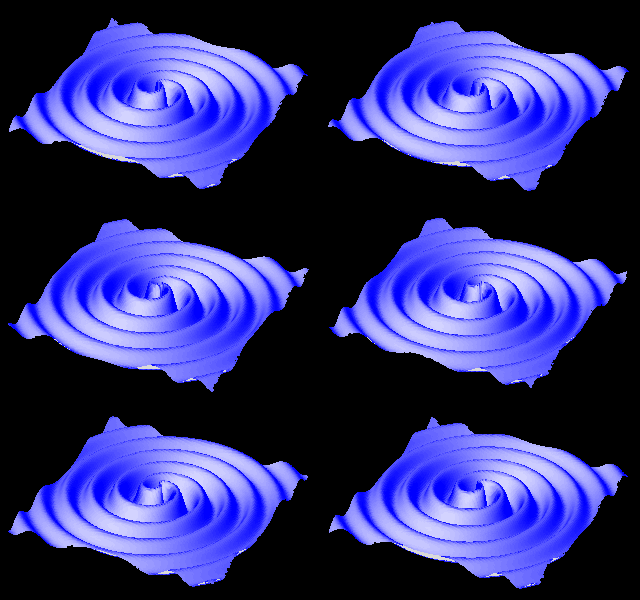
Credit : Wikimedia
Scientists of LIGO successfully discovered the ripples caused by the collision of two massive Black holes, 1.3 Billion years ago.  But how do they detect it?

When the ripples in the fabric of space time reaches an object, it can make it stretch and squeeze. The ripples from the collision of those Black holes can make entire Earth expand and contract by 1/100,000 of a nanometer, that is about the width of an atomic nucleus. That is absolutely miniscule. For detecting such a minute wave, we need an extra precise device.

Thus we made the LIGO (Laser Interference Gravitational-Wave Observatory). LIGO comprises of 'L' shaped device called interferometers, with arms of 4 kms long and about a little more than a meter wide. Let's see its working.

In LIGO, laser beams are passed through the arms of the device, at the same time. At the end of each arm, there is an ultra precise mirror, which will reflect back the laser. Laser then travels back and the two beams will join at one point and overlaps and creates an interference pattern. This pattern will be the same, every time the laser overlaps, when there is no gravitational wave. When a gravitational wave passes by, one arm will get stretched and the other get squeezed, thus making differences in the length of both the arms. If the beams travel different distances, then while overlapping, it creates a different interference pattern. These changes in patterns are noted to detect gravitational waves. LIGO is capable to detect a minute distance change of 1/10,000 the width of a proton.

LIGO, gravitational waves, hanford, livingston
Signals seen in Livingston and Hanford detectors. Credit : LIGO
As LIGO is so sensitive, even a movement of truck or distant ocean waves can shake the mirrors, thus causing difference in measurement. The main trouble scientists face was to clear off the noises. The mirrors were hung from quadruple pendulum to isolate the external shaking. And also, the readings of two observatories (at Hanford, Washington and Livingston, Louisiana), which is 2000 miles apart, are taken and analysed to eliminate the local shakes, that are felt by a single observatory, while the authentic cosmic gravitational waves will felt by both.

That's it. That is how scientists discovered the gravitational waves. Now you maybe asking, what is the significance of this discovery? One thing is that, Einstein's Theory of Relativity is again found to be correct. And also it proved Hawking's predictions on Black Holes. Besides that, we got a new form of media to know the Universe. We were searching and knowing the Universe only by using electro magnetic waves till date. Now we have got a new way of 'seeing', that can lead to many stupendous discoveries.

The sensitivity of LIGO will further enhanced until it reaches the design sensitivity on 2021. We can expect many more detections and improve the knowledge on how Universe works.

For more detailed reading, you can download the press release from LIGO here, http://www.ligo.org/news/detection-press-release.pdf

Monday, 8 February 2016

Ever wondered why we can't see small things?


Why we don’t see bacterias every day? We know microorganisms are everywhere, its in the air we breathe and the water we drink. Its in-front of our eyes. Then why can’t we see them? Why can't we see small things? To understand that, first we have to know how we SEE things.

Everyone knows, we see things when light from an object falls on our eyes. But how that image reach us? Does light carry information of that image? Yes, in the sense, each photon in the light ray have a different wavelength that matches the colour of the object where it is emitted or reflected. Each photon acts like a pixel of an image. When this light ray reaches our eyes, the signals are detected by the cones and rods in the retina.

Cones detect the colour and the rods detect the brightness. The brain will then formulate the image using this information. Now lets see, what’s the problem while viewing smaller objects. 

The photons that can be detected by our eyes has a limit. A typical human eye is capable of detecting the visible light with wavelength ranging, 390nm to 700nm. We are not adapted to see infrared, ultraviolet, radio waves etc. 

The reason we cannot see too smaller objects is that the wavelength of visible light is much bigger than the size of that object. The photons of visible range (390nm to 700nm) when reflected from smaller objects, like an atom, is too weak. Since an atom is very small compared to the wavelength of visible light, the wave equation requires that the light bounce off with a very broad spread of directions, not at all like reflection from a surface. Thus it makes hard to detect an atom.


Even using a conventional microscope, its hard to see objects below the length of the minimum wavelength of visible light, because a conventional microscope uses visible light to detect objects. It simply magnifies the things it detects.

So what should we do to see an atom? We makes use of an Electron microscope. In an electron microscope, the light source is replaced by a beam of fast moving electrons. As the electron's size is too small, it can successfully create image of smaller objects.

There are several types of electron microscopes for various uses. You can find the details and differences from here : http://www.explainthatstuff.com/electronmicroscopes.html


If you are wondering, the tiniest objects we can see is about 0.1mm, it is the size of a hair, lice etc.

Saturday, 6 February 2016

The story of Rosetta and Philae - Cartoon series from ESA


Credit : ESA

ESA's mission to the comet 67p (Churyumov-Gerasimenko) is pictured as a kid friendly cartoon animation series. It tells a brief real life story of the Rosetta mission. No doubt, its not only for kids, but for us adults too. So much informative and with a heart warming storyline to make it understandable for all the ages. ESA released the cartoon in 5 languages (English, Italian, French, Spanish and German). Here I'll provide the playlist in English. For other videos you can check out ESA's Youtube channel.

Rosetta Philae cartoon

  • Wake up Rosetta
  • Are we there yet?
  • Comet landing
  • Living with a comet
Here is the playlist - ESA Rosetta and Philae Cartoon

The journey is still continuing and we have to wait for the next event to happen in the mission, to watch the next episode.

Wednesday, 3 February 2016

Know the Constellation - Canis Major


Last time we checked out the Orion constellation. Now its time for Canis Major. Canis Major is located in the southern celestial hemisphere. The name literally means, "The big dog". Canis major, beside the much smaller constellation, Little Dog, is commonly portrayed as accompanying the legendary hunter, Orion. It contains largely of young blue stars. The most important stars within the constellation are, Sirius, Adhara, Wezen and VY canis Majoris.

Sirius, the brightest star in the night sky, is a Spectroscopic Binary star. It is twice as bright as Canopus, the next brightest star. It appears bright because of both Sirius's intrinsic luminosity and proximity to Earth. Sirius is twenty five times additional luminous than the Sun, however features a considerably lower brightness than other bright stars like Canopus or Rigel. Sirius system is one of Earth's near neighbours.It is approx. 9 light years from Earth.The sky location for Sirius is : RA 06h 45m 08s, Dec -17°16' 42".

Know the basics of sky gazing, Sky Gazing for Beginners - Part I


Adhara is a star in Double system. It is the second brightest star in the constellation. The name Adhara came from Arabic, meaning "Virgins". It is one of the brightest known extreme ultraviolet sources in the sky. About 4,700,000 years ago, Adhara was only 34 light years from the Sun, and was the brightest star. It is approx. 405 light years from Earth. The sky location for Adhara is : RA 06h 58m 38s, Dec -29°01' 41".

Wezen is a yellow-white supergiant variable star. It is approx. 1607 light years from Earth. The sky location for Wezen is : RA 07h 08m 23s, Dec -27°36' 25".


VY Canis Majoris is a single star categorised as a semi regular variable with an estimated period of 2,000 days. If placed at the position of Sun, VY Canis Majoris's surface would extend on the far side the orbit of Jupiter, though there's still sizeable variation in estimates of the radius. It is approx. 4892 light years from Earth. The sky location for VY Canis Majoris is : RA 07h 22m 58s, Dec -25°46' 03".

How Small is an Atom?


Atoms are ridiculous and unbelievably small. A single human hair is about as thick as 500,000 carbon atoms stacked over each other. Look at your fist, it contains trillions and trillions of atoms. If one atom in it were about as big as a marble, how big would your fist be? Well… about the size of Earth. Hm… still hard to imagine? Let’s try something different.

Look at your little finger. Imagine that its tip is as big as the room you’re sitting in right now. Now fill the room with grains of rice. One rice corn represents one cell of your fingertip. Now let’s zoom in on the rice corn. And now, one cell is as big as the room you’re in right now. Let’s fill it with rice again. This is about the size of a protein. And now, let us fill all the empty spaces between the rice corns with fine grains of sand. This is roughly how small atoms are. What is an atom made of? 
Let us just pretend that atoms look like this for a minute to make it easier to understand. An atom consists of three elementary particles: neutrons, protons and electrons. Protons and neutrons bind together and form the atom core, held together by the strong interaction, one of the four fundamental forces in the universe. They are made from quarks and held together by gluons. Nobody knows exactly how small quarks are. We think they might literally be points, like in geometry. Try to imagine them as being zero-dimensional. We suspect that quarks and electrons are the most fundamental components of matter in the universe.

Electrons orbit the atom core. They travel at a speed of about 2,200 km/s, fast enough to get around the Earth in just over 18 seconds. Like quarks, we think electrons are fundamental particles. 99.999999999999% of an atom’s volume is just empty space Except that it isn’t. What we perceive as emptiness is actually a space filled by quantum fluctuations, fields that have potential energy and build and dissolve spontaneously. These fluctuations have a fundamental impact on how charged particles interact. How much space do the core and electrons actually fill? If you were to subtract all the spaces between the atom cores from the Empire State Building, it would be about as big as a rice corn. All the atoms of humanity would fit in a teaspoonThere are extreme objects where states like this actually exist. In a neutron star, atom cores are compacted so densely that the mass of three Suns fits into an object only a few kilometres wide. By the way, what do atoms look like? Well, kind of like this. 


Electrons are like a wave function and a particle at the same time. We can calculate where an electron might be at any given moment in time. These clouds of probability, called orbitals, are where electrons might be with a certainty of 95%. The probability of finding an electron approaches 0 the further we get away from the atom core, but it actually never is zero, which means that, in theory, the electron of an atom could be on the other side of the universe. 

Okay, wait a second. These strange thingies make up all the matter in the universe. For many dozens of known elements, you don’t need many dozens of elementary particles, just three. Take one proton and one electron, and you have hydrogen. Add a proton and a neutron, you have helium. Add a few more, you get carbon, a few more, fluorine, even more, gold, and so on. And every atom of an element is the same: all hydrogen atoms in the universe, for example, are the same. 

The hydrogen in your body is exactly the same as the hydrogen in the Sun

Tuesday, 2 February 2016

How Big is the Universe?


Space is too huge that humans find it difficult to sense it’s humongous size. The units to measure earthly distances wont quite works for cosmic distances. Distance within Solar System is often measured in Astronomical Unit (AU). It is the distance between Sun and Earth. Even AU becomes less helpful when the distances get much larger. In that case, the unit Light Year, comes to the rescue. (Parsecs are also used. 1 Parsec is 3.26 Light years) Light Year is the distance, light travels in a year. Remember, light travels 299,792,458 metres in a second. These are mind boggling distances, completely foreign to our day-to-day experiences, making it hard to grasp the size of this vast Universe. The easy way to tackle this is to make an analogy for the large distances with smaller ones that we can easily relate. Here’s a trick,

1 light year = 5.879 x 10¹² miles

1 AU = 9.296 x 10⁷ miles

5.879 x 10¹² miles / 9.296 x 10miles = 63242.25

That implies, 1 light year equals around 63242 AU.

And 1 Mile comprises, 63360 inches.

Thus we can take inch - Mile analogy for AU - lightyear relation.

With this relation, you can get a better grasp on the distances of the vast Celestial objects. Now lets consider, Sun and Earth are 1 inch apart, then a light year would be exactly 1 mile. Then Jupiter would lie 5.2 inches away and Pluto around 40 inches away. In this analogy, the nearest star, Proxima Centauri is roughly 4.2 miles away. The star Vega would be 26 miles away, Orion Nebula 1340 miles away, and the globular cluster M15 some 25,000 miles distant (about three times the diameter of the Earth).

On this massively compressed scale, the diameter of the Milky Way Galaxy itself would be about 100,000 miles. And to prove human’s miserable sense of scale, the radius of the observable universe would be 46.6 billion miles. Still finds it hard to imagine huh?

Puny humans!!


Star Gazing for Beginners - Part III


If you haven't gone through the first and second parts, please have a look on it, Star Gazing for Beginners - Part IStar Gazing for Beginners - Part II


Transcript:


Hi I’m David Fuller from the “Eyes on the Sky” video series. In this last Stargazing Basics video, we’ll learn how to easily measure distance in the sky, so you can find constellations or objects more easily either naked eye, with binoculars or telescopes. In our first video, we learned that a line called the meridian splits the sky into equal halves, from north to south. If we were to place a giant protractor in place of that line, it would appear as if the sky was 180 degrees from horizon to horizon. Although space is actually infinite, our eyes make the night sky appear like a “half sphere,” so for all practical purposes, it’s easier to think of the sphere. And though a sphere should technically be measure in radians, degrees is a concept people understand more readily and works for our purposes. So horizon to horizon is 180 degrees – that’s easy enough. And if we measured another large distance, from horizon to zenith, that would produce a right angle, or 90 degrees. Still pretty simple, right? But to measure smaller angles than that, we need a measuring tool. A ruler doesn’t work, because that would be for linear measurement, and holding a protractor to our eyes is a bit impractical. So what to do? Easy: Use your hands!

Check this out: Hold out your hand at arm’s length. Now spread your thumb and pinky as far away from each other as possible. If you look across your thumb and pinky, that distance is approximately 25 degrees. Don’t worry – this works for almost everyone. Don’t believe me? Look for the Big Dipper in the night sky. See the last two stars in the “Bowl” of the dipper? Draw a line through them, from the “bottom” of the bowl towards the top. Now hold your hand at that top star, along that line. The other side of your outstretched hand should be near Polaris, the north star, because that distance is NEARLY 25 DEGREES. But sometimes we need to measure smaller distances than 25 degrees. This time, hold up your forefinger and pinky, and stretch them out. The distance across them is about 15 degrees. This is about the distance from Orion’s belt to the star Aldebaran – this way – or the star Sirius, going this way. You can find these stars in the winter sky.

Img Credits : squarespace.com

For another smaller tool, hold up your fist. Across the top of your fist from side to side is about 10 degrees of sky. We can ‘calibrate” that by looking at FIND A GOOD CIRCUMPOLAR CALIBRATION. Two split that in half, now hold up these three fingers – this approximates 5 degrees of sky. Those two stars at the end of the Big Dipper are about 5 degrees from each other. Hold up your hand and see if your fingers match that. And lastly, the one degree tool. Simply hold up your pinky! This one amazes many people, because the actual angular distance across the Full Moon is only half of a degree. So holding your pinky at arm’s length, you can cover the WHOLE Moon! Of course, mixing and matching these can help you find even more – two hands like this can measure halfway across the 90 degrees of horizon to zenith, approximating 45 or 50 degrees or so. Use other combinations to create 30, 35 or 40 degrees, just by using two hands. 

But how will you know how far an angle is in the sky from a star chart? The declination lines will tell you degrees, but only in that direction. Try downloading the “Skymaps” all sky star charts each month. These charts are about 180 millimeters across. Though not terribly useful at the edges, as the sky diagrams are “stretched” there, you can use a simple ruler with millimeters on it to measure approximate angular distances in the sky, helping you “hop” from bright stars or well known constellations, to dimmer ones. Give it a try – it’s really easy, and works for just about everyone. Thanks for watching; I’m David Fuller. Keep your eyes on the sky and your outdoor lights aimed down by using dark sky friendly lighting fixtures, so we can all see, what’s up. 

What's inside an Atom?


In the early 1900’s, the atom was considered the ultimate, indestructible unit of matter. They believed, atoms of the then known elements, such as oxygen, nitrogen, hydrogen and others, could not be broken down into anything simpler. But later, certain experiments like ionic dissociation and the cathode ray tube, indicated the existence of subatomic particles. These and other experiments lead to the knowledge of the proton, electron and neutron as the basic subatomic particles.

Proton: charge = +1, mass = 1.67 x 10⁻²⁴ kg
Electron: charge = -1, mass = 9.11 x 10⁻²⁷ kg
Neutron: charge = 0, mass = 1.67 x 10⁻²⁴ kg

Physicists thus have discovered that atoms are not solid and that electrons rotate around the nucleus and complex orbits. But the understanding of atoms stopped with the electrons, protons and neutrons? The answer is No. 

Modern physics examines particles at the sub-atomic level. Some of the smallest particles are called Quarks. Quark Theory has been around since the mid-nineteen sixties. But a Quark has never been isolated. No one has ever seen a Quark. So you might ask how do scientists know they exist? The answer comes from data collected at high-energy particle accelerators.  Particles are accelerated to nearly the speed of light around the long distant underground tract and smashed together. By studying the patterns made by the new particles that are created in the collisions, scientists are able to determine the properties of the particles and their interactions. The tests have been repeated and the results have been duplicated with enough experiments to convince us that quirks are real and just as fundamental today, as the familiar electron, proton and neutron, were once thought to be. Quarks come in three paired types, that physicists call flavours. They are,

Up and Down
Charm and Strange 
Top and Bottom


Up and down were named based on components of their spin. Strange quarks were given the name, strange because they were observed in particle decays that had slightly longer lifetimes than they should have done. The charm quark was given the name because of it's fascination. The way that it fascinated the physicists at the time. Bottom and Top quarks were chosen by a famous physicist named Haim Harari. He chose the names because they were the logical counterparts of the up and down quark. 

These Quarks are bind together with the help of Gluons. Gluons are hypothetical massless subatomic particle, believed to transmit the force binding the quarks together in a hadron. Gluons mediate the strong force. They have no mass and no electric charge.

Monday, 1 February 2016

Star Gazing for Beginners - Part II


If you haven't gone through the first part, please have a look on it, Star Gazing for Beginners - Part I

Transcript:

Hi I’m David Fuller from the “Eyes on the Sky” video series. Let’s look at another aspects of Stargazing Basics, this time, magnitudes of various objects. Magnitude is just a fancy way to describe the difference in brightness of objects we see in the night sky. And it’s not too hard to learn how it works, but let’s start with some history. The Greek astronomer Hipparchus developed the magnitude scale back in the 2-nd century BC, when he assigned the brightest stars a magnitude of “one” and the dimmest stars that of “six,” the in-between stars of 2, 3 , 4 and 5 magnitude assigned according to brightness. He assumed that the difference in brightness of stars was 2.512 times brighter than the next dimmest one. Taken across that full 6 magnitude scale, this meant that the brightest stars – the first magnitude ones - were 100 times brighter than the dimmest, 6-th magnitude ones. It also allows for a fairly easy way to determine other brightness differences: The difference from first to third magnitude is 6.3 times; first to fourth, 15.8, first to fifth , about 40 times.


This worked just fine until Galileo turned a telescope towards the heavens, and humans discovered there were a LOT more stars out there than just the first through sixth magnitude ones they could see naked eye. But what they did was just extrapolate the scale further. So much like golf or ERA in baseball, the lower the number, the brighter the star, and the higher the number, the dimmer the star. 11-th magnitude is 100 times dimmer than 6-th magnitude, and that 11-th magnitude star would also be 10,000 times dimmer than a first magnitude star. In the other direction, we have some objects that are brighter than first magnitude stars. Hipparchus actually fudged the numbers a bit; the star Sirius in the winter sky is definitely brighter than most other bright stars, and it shines at magnitude negative one point four. The planet Jupiter is brighter than that, often appearing at around magnitude negative 2, and Venus brighter still, typically around negative four. When objects are bright, they are denoted on star charts with larger dots; dimmer stars are usually given smaller dots. This helps us locate brighter objects in the sky more easily. But beyond the stars’ magnitudes is that of the Moon and Sun. 

The full Moon in the night sky shines at magnitude negative 12.7, and the Sun at magnitude negative 26.7! Those are both bright compared to starlight, but also a huge difference, even between themselves, as the Sun is 400,000 times brighter than the full Moon! Now everything we have discussed has been “visual magnitude,” meaning how bright or dim objects appear to our location on Earth. Another concept is “absolute magnitude,” used by astronomers to compare the relative brightness of objects when placed the same distance. But that is more complex than what we need to know for simple stargazing purposes. However, for visual magnitude, it helps to understand how it relates to other objects besides stars. Stars are point-like objects in the sky, so it is easy to assess their magnitude and brightness. But galaxies, star clusters and nebula are not quite as easy. So we look at their “integrated magnitude.” That’s a way of saying that the same magnitude is now spread out over a larger area. For small objects, that can mean it is something that will look brighter to us in telescopes. If the area if very large though – such as the galaxy M33 or the nebula M1, those objects may look very dim, relatively speaking. If possible, try to look for the surface brightness of an object; objects above a surface brightness of 11 or 12 can be very difficult to find from light polluted areas. 


That’s a quick overview of the magnitude scale, and how to understand it. Just remember the Sun and Moon have negative magnitudes and are the brightest visual magnitude objects, and lower numbers are dimmer stars and objects, and you’ll be in good shape! Thanks for watching; I’m David Fuller. Keep your eyes on the sky and your outdoor lights aimed down by using dark sky friendly lighting fixtures, so we can all see, what’s up. 

Star Gazing for Beginners - Part III

Everything you need to know about the newly discovered Elements


Img Credits : wired.co.uk

The International Union of Pure and Applied Chemistry (IUPAC) announced that four new elements will be joining the other 114 on the periodic table of elements. The addition of elements 113, 115, 117 and 118 means, the seventh row or period is now complete! They still don’t have proper names yet, they’re just called by their numbers. So where did these as yet unnamed elements come from? Scientists from Lawrence Livermore National laboratory in California and the Riken institute in Japan, smashed atoms together in particle accelerators and these new elements were created when the two nuclei fused. But the new elements existed only for a fraction of a second. Then they decayed into isotopes of other elements.


Element 113, the one created in Japan, exists for less than a thousandth of a second before it decays into other isotopes, so it’s unlikely you’ll run into this element anytime soon. So alright, sweet new elements. While cool, it probably won’t mean much for your daily life, yet. Unless you have to memorise the entire table in chemistry class, sorry 10th graders. But for science, it could be huge. Scientists have been searching for the elusive “Island of Stability," which according to a theory by Nobel laureate Glenn Seaborg is a stable element with just the right number of protons and neutrons. And these new elements might be getting scientists closer to the island of stability.
Img Credits : iflscience.com

You see, most heavy elements, ones with more than 113 protons like these new ones, only exist for a short amount of time. That’s because the force of the positive charges of their protons is too strong and the nucleus is pushed and pulled apart in a fraction of a second. But just like atoms become stable when their outer electron shells are full, some researchers, like Seaborg, believe that if a nuclei has a certain number of proteins arranged in just the right way, the element would be stable, it could last. If we can create this theoretical stable element it could be used to build things we haven’t even imagined yet! Even the effort of doing so, teaches scientists "a tremendous amount of just basic nuclear physics." According to Seaborg, the magic number to hit is 114 protons and 184 neutrons. 

And after  years of trying, Seaborg’s mentee Ken Moody finally hit the sweet spot by slamming together plutonium and calcium which briefly created a new element. Unfortunately, while the element, now called flerovium, or Fl has 114 protons it doesn’t have the needed 184 neutrons, and so it fell apart too quickly. Element 117, has been heralded as a possible “shore to the island of stability”. Five years ago, A U.S.–Russian team first created it at the Joint Institute for Nuclear Research in Dubna, Russia. Described in a journal Physical Review Letters, this new element has a half-life of about 50-thousandths of a second. Which means in that short of a time, half the element will decay into other isotopes like lawrencium-266, which had 103 protons and 163 neutrons, a combination never seen before. This lawrencium-266 even lasted a long time for an isotope, with a half life of 11 hours. Because of this, one of the lead authors said “Perhaps we are at the shore of the island of stability.” 


So, maybe, science is one step closer to creating a new element which we could use in ways we haven’t even dreamed of. And though we’re not there yet… we’re getting closer. It’s clear more research is needed. There’s no theoretical limit to how big elements can get! One day scientists might just start filling out the elusive 8th row! So don’t change your shower curtain just yet.

Credits : DNews

Sunday, 31 January 2016

Know the Constellation - Orion


Orion, often referred to as The Hunter, is a prominent constellation located on the celestial equator and visible throughout the world. Orion got its name from Greek Mythology. The story says, Orion was a giant hunter whom Zeus Placed among the stars as the Orion Constellation.


The brightest stars in Orion are Rigel and Betelgeuse

Located in the constellation Orion, Rigel is a Pulsating Variable Star. It is the brightest object in Orion,Rigel is approximately 863 light-years from earth. The sky location for Rigel is : RA 05h 14m 32s, Dec -09°47' 54"

Know the basics of sky gazing, Sky Gazing for Beginners - Part I


Betelgeuse is a Semi-regular Pulsating Star with distinctly reddish-tint. It is the second brightest star in Orion. It is also known by Betelgeuse's Bayer designation Alpha Orionis and is the ninth brightest star in the night sky. It is approximately 498 light-years from earth. Betelgeuse marks the upper right vertex of the Winter Triangle and center of the Winter Hexagon. Betelgeuse is expected to explode as a type II supernova. The sky location for Betelgeuse is : RA 05h 55m 10s, Dec +07°24' 26"


You can locate Sirius, the brightest star in the night sky, by using the belt of Orion. The belt points South East directly toward Sirius. Sirius is in the constellation of Canis Major and it is the fifth-nearest known star with a distance of just 8.7 light-years from earth.

What is Evolution?


Stated Clearly


Transcript

What is Evolution?

In Biology, the theory of Evolution doesn’t tell us exactly how life began on earth, but it helps us understand how life, once it came into existence, diversified into the many incredible forms we see now and in the fossil record. It also helps us make sense of the way in which modern creatures continue to adapt and change today. In biology, evolution can be defined as any change in the heritable traits (those are physical traits like fur color in mice, spots on the wings of butterflies, or instinctive traits like the way in which dogs greet their friends with a sniff) within a population, across generations . This definition can be a bit confusing so let’s see how it works.

All healthy living things, from single celled amoebas, to flowers, to dolphins: are capable of reproduction. We have children, we make copies of ourselves. We do this by duplicating our DNA and passing that DNA on to future generations. DNA is a chain like chemical stored inside each one of your cells, which tells them how to grow and function. Your DNA contains coded information on how to build you. The information in your DNA is different than that of, say, a daffodil’s DNA which is why you look and function differently than a daffodil. The information in your DNA is slightly different than that of Elvis Presley, which is one of many reasons you don’t look or act quite like he did.


Single celled amoebas (and other simple creatures) reproduce by copying their DNA inside their guts, moving both copies to either side of their body, splitting in two right down the middle, and then growing back to full size. If all goes well, the two new amoebas will be exact copies of each other, but in nature, things aren’t always perfect. When DNA is being copied, errors can occur which modify the DNA code. This is what we call a DNA mutation. These mutations (which happen completely on accident and randomly to any part of a DNA strand) can produce variation in the body shape and function of the creature who inherits the modified DNA.

In this case, our new little friend has an arm that stretches extra long. If he survives to grow and reproduce, that extra stretchy arm (which is now coded for in his DNA) will be passed on to his children. Evolution, any change in the heritable traits within a population, across generations, has officially occurred. As you know, reproduction for Dolphins and badgers and people, is a little more complicated. We have to find ourselves a partner. When two badgers get together and... ya know, fall in love, a sperm cell from the father (which contains a copy of half of his DNA - ONLY half), combines with the egg cell of the Mother (which contains half a copy of her DNA). The result is a new cell with a complete set of DNA instructions, all the information needed to divide and grow up into a brand new badger.

The new child matures to be similar to her parents but also unique because she developed some traits from her mother’s DNA and some from her father. Her new combination of traits can be passed to her children and again, evolution, any change in the heritable traits, within a population, across generations, has officially occurred.


Besides the unique recombination of her parents traits, she might also have developed some completely new traits due to DNA mutations. Maybe extra hairy ears for example. If she survives long enough to have kids of her own, her DNA will combine with the DNA of her partner, and she’ll pass on those extra hairy ears to at least some of her children. This of course, is also evolution. So there you have it, evolution is really pretty simple. Scientists and normal folks everywhere, witness evolution happening all around them  
Small changes like the ones we’ve seen here can add up over multiple generations to create dramatic changes.

If you were to go back in time just a few thousand years, you’d find that all dogs for example, originally evolved from an ancestral group of gray wolves. The evolution of those wolves, from generation to generation, was guided by humans. People were selecting wolves with traits they liked, letting them breed, and then only keeping the puppies with the most desirable traits. As time went on, different breeders preferred dogs with different features, some selected for large size, some for small size, some for brains, others for braun. Today, wolves have branched out into hundreds of dog breeds, very few of which look and behave much like their ancestors.
A massive amount of observable evidence from many of different fields such as Genetics, Chemistry, Paleontology and Mathematics, overwhelmingly suggest that just like all dogs share a common ancestor, all living things; me; you; puffer fish; banana trees; if you go back far enough, also share a common ancestor. We are literally related.


We don’t know what the first life form was or exactly how it came to be, but the simple process of reproduction with variation over billions of years looks to be responsible for all the diversity in of life we see today. Now you might be saying: “Wait a minute! Hold on here. Isn’t evolution random? To do something functional like turn a wolf into an adorable mini poodle, random evolution had to be guided by a dog breeder. Researchers say all mammals evolved from an ancient shrew like creature but the difference between a shrew and an elephant is far greater than that of a wolf and a poodle. Who guided that process? Who was the breeder?”

In the mid 1800s two men, Charles Darwin and Alfred Russel Wallace independently discovered, that a breeder is not necessarily needed. There is another force capable of guiding random evolution to produce order and complex function. They called it Natural Selection which happens to be the entire topic of our next video, but before you move on let’s recap what we have learned so far.

Biological evolution is any change in the heritable traits within a population across generations. All healthy living things can make copies of themselves, but they do so imperfectly. Small variations can add up over time to create dramatic differences in body form and function. Evidence overwhelmingly suggests that all living things are related.
So remember, next time you invite family and friends over for a holiday feast, you’re actually just inviting family. That includes the turkey and the pumpkin in the pumpkin pie.