Showing posts with label Cosmology. Show all posts

Thursday, 11 February 2016

Everything about LIGO and the Gravitational Waves


Ligo detector, hanford, gravitational wave, LIGO
LIGO detector at Hanford, Washington. Credit : LIGO Laboratory

"Ladies and gentlemen, we have detected gravitational waves. We did it!". 

Yesterday (11 Feb 2016), physicists at LIGO, officially declared the discovery of gravitational waves. Rumours have been spread months before the declaration and medias were going frenzy. Scientific world was eagerly waiting. Words of the notable physicist, Lawrence Krauss, before the official declaration, "New era in Astronomy and Physics could begin". It is said to be the discovery of the century.  

But why this fuss? Why scientists are going crazy about this? Is it going to change our understanding of the Universe?

Credit : sciencenews.org
First let us know what a gravitational wave is. The concept of gravitational wave was put forth by the renowned scientist, Albert Einstein, through his mind numbing, General Theory of Relativity. According to General Relativity, space and time are aspects of a single measurable reality called spacetime. The objects in space can create warps in the fabric of spacetime. More massive the object, more the warping would be. This curves in the fabric of spacetime is the reason behind the gravity

Moon does not revolve around earth, as earth pulls it, instead it takes the direct path in four dimensional spacetime. 

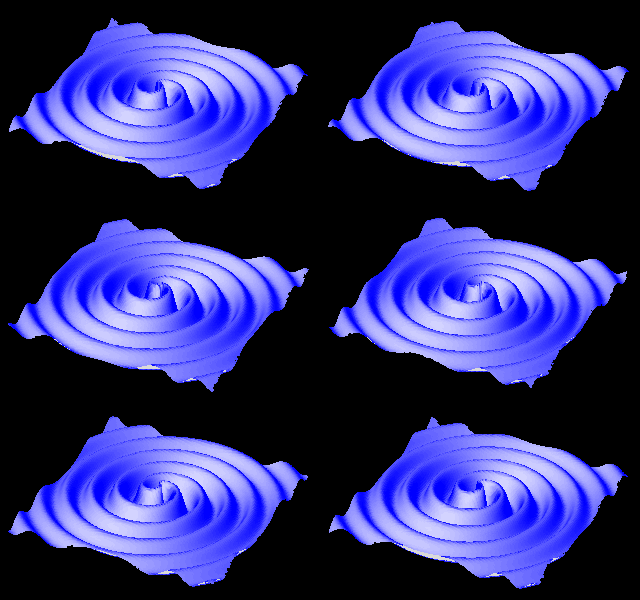
If the spacetime can be warped like a fabric, then it can be rippled also. It will ripple when there is a sudden movement of massive objects. If an object, big or small, is sitting still or in constant motion, it's gravitation field will be static and there won't be any gravitational wave. But when it moves suddenly (speeding up, slowing down or changing direction), like in an explosion, then its gravitation filed changes and causes the ripples in spacetime. Such ripples in the fabric of spacetime are called as gravitational waves. Earth too gives off gravitational waves, but its extremely weak and faint.
Credit : Wikimedia
Scientists of LIGO successfully discovered the ripples caused by the collision of two massive Black holes, 1.3 Billion years ago.  But how do they detect it?

When the ripples in the fabric of space time reaches an object, it can make it stretch and squeeze. The ripples from the collision of those Black holes can make entire Earth expand and contract by 1/100,000 of a nanometer, that is about the width of an atomic nucleus. That is absolutely miniscule. For detecting such a minute wave, we need an extra precise device.

Thus we made the LIGO (Laser Interference Gravitational-Wave Observatory). LIGO comprises of 'L' shaped device called interferometers, with arms of 4 kms long and about a little more than a meter wide. Let's see its working.

In LIGO, laser beams are passed through the arms of the device, at the same time. At the end of each arm, there is an ultra precise mirror, which will reflect back the laser. Laser then travels back and the two beams will join at one point and overlaps and creates an interference pattern. This pattern will be the same, every time the laser overlaps, when there is no gravitational wave. When a gravitational wave passes by, one arm will get stretched and the other get squeezed, thus making differences in the length of both the arms. If the beams travel different distances, then while overlapping, it creates a different interference pattern. These changes in patterns are noted to detect gravitational waves. LIGO is capable to detect a minute distance change of 1/10,000 the width of a proton.

LIGO, gravitational waves, hanford, livingston
Signals seen in Livingston and Hanford detectors. Credit : LIGO
As LIGO is so sensitive, even a movement of truck or distant ocean waves can shake the mirrors, thus causing difference in measurement. The main trouble scientists face was to clear off the noises. The mirrors were hung from quadruple pendulum to isolate the external shaking. And also, the readings of two observatories (at Hanford, Washington and Livingston, Louisiana), which is 2000 miles apart, are taken and analysed to eliminate the local shakes, that are felt by a single observatory, while the authentic cosmic gravitational waves will felt by both.

That's it. That is how scientists discovered the gravitational waves. Now you maybe asking, what is the significance of this discovery? One thing is that, Einstein's Theory of Relativity is again found to be correct. And also it proved Hawking's predictions on Black Holes. Besides that, we got a new form of media to know the Universe. We were searching and knowing the Universe only by using electro magnetic waves till date. Now we have got a new way of 'seeing', that can lead to many stupendous discoveries.

The sensitivity of LIGO will further enhanced until it reaches the design sensitivity on 2021. We can expect many more detections and improve the knowledge on how Universe works.

For more detailed reading, you can download the press release from LIGO here, http://www.ligo.org/news/detection-press-release.pdf

Friday, 5 February 2016

Big Bang : The Origin of the Universe


Big bang

Credit : NASA / WMAP/ Wikimedia Commons

How the universe began? The answer is universe popped out from nothing. Yes. It just came out from nothing. That is what, the great ‘Big Bang’ theory suggests (not the TV show). 'Nothing' means there was absolutely nothing. No space and no time. Time itself started from Big Bang. But what in the world, triggered the Big Bang? 

First thing you should know is, there is no OUTSIDE for our universe. The space and time exists within our universe itself and they came into existence after the Big Bang. So, the question what caused the Big Bang posses a serious issue of causality. There was no BEFORE to the event, Big Bang.

The word Big Bang misleads the public as it was an explosion in space. But it's not true, it was actually the appearance of space everywhere in the universe. It was a rapid expansion of space, analogous to the inflation of a balloon.

Now lets see the events happened in the beginning. The first event, modern physics is capable to understand, happened at hundredth of a billionth of a trillionth of a trillionth of a second after the Big Bang. That is too small. This time is called a Planck Time (10-43 sec). No one knows what happened before and has less idea during the Plank Time, after the Big Bang. Einstein’s General Relativity suggests, there was Gravitational Singularity before this time.

All the ideas about the very early universe are speculations. We don’t have sufficient insights about those time.

Early Universe
- Plank era (10-43sec) to Quark era (10-06sec)

quark-gluon plasma

Credit : Cern

At Plank era, the four fundamental forces (electromagnetic force, weak and strong nuclear force and gravity) all had the same strength, and acted like a single fundamental force, held together by a perfect symmetry. At this time the Universe was expanded to a length of only 10-35 metres (Planck Length) and had a temperature of enormous 1032°C (Planck Temperature). The universe was an infinitely dense, hot fireball.

10-43 sec to 10-36 sec - gravity separated from the fundamental force and leads to creation of the earliest elementary particles (Quark-Gluon plasma or the "quark soup"). 

10-36 sec to 10-32 sec - the strong nuclear force separated and triggered the rapid exponential expansion of the universe, which is known as Cosmic Inflation.

10-32 sec to 10-12 sec - leads to the formation of Exotic particles like WIMPs (Weakly interacting massive particles, the fundamental particles of Dark Matter), neutrinos, Higgs Bosons etc.

10-12 sec to 10-06 sec - all fundamental forces become distinct and took their present form. Quarks, electrons, neutrinos etc were formed. Quarks and antiquarks annihilate each other on contact. But a quark for every billion pair survived from annihilation, thus forming the building block of matter.

Formation of Basic Particles

- Quark era (10-06sec) to Nucleosynthesis (20 mins)

nucleosynthesis
Credits : uoregon.edu

At this time period, the universe cooled down and became less dense. The elementary particles smashed together leading to the formation of nuclei.

10-06 sec to 1 sec - quarks smashed each other to form hadrons (protons, neutrons etc). Electrons collided protons to give neutrons and massless neutrinos.

1 sec to 3 mins  - leptons (electrons) and antileptons (positrons) collide each other and annihilate and that lead to release of energy in the form of photons.

3 mins to 20 mins - temperature again fell down. Nuclear fusion started and formed atomic nuclei of hydrogen, helium, lithium etc.

Formation of Atoms and Elements 
- Nucleosynthesis (20 mins) to Dark Age (150 million years)

dark ages in cosmology

Credit : naoj.org

The temperature of the universe fell down again to the temperature of the surface of sun. Elements were created but still no activities of star creation occurred. Cosmic Background Radiation, we see today, started to emit.

3 mins to 240,000 years - universe was a breeding ground of nuclei, and was plenty with plasma of atomic nuclei and electrons. The energy of the universe was mainly from photons which interacted with, protons, neutrons and nuclei.

240,000 years to 300,000 years - formed the first atoms after nuclei captured electrons to neutralise. Universe become transparent to light, photons started travelling freely.

300,000 years to 150 million years - this period is called as the dark age, it is time period between the formation of atoms to the formation of first stars. Universe was dominated by Dark matter.

Formation of Stars and Galaxies 
- Dark Age (150 million years) to Present Day (13.8 billion years)

Cosmos

Credit : universoracionalista.org

This was the period of quasars, stars, galaxies, black holes, neutron stars, supernovae and everything we see today. Universe continues to expand rapidly.

150 million years to 1 billion years - quasars began to form due to gravitational collapse and the universe was composed of ionised plasma. Started formation of stars and due to gravity, formed galaxies and clusters and superclusters of galaxies.

8.5 billion years to 9 billion years - Late generation star, sun was formed from the debris of many generations of stars and the solar system around it formed around 4.5 to 5 billion years ago.

Today, 13.8 billion years - to be exact 13.799±0.021 billion years from the Big Bang. The universe is still expanding and a vast breeding ground of celestial objects.


We have no idea how vast the Universe is and still lots of surprises to be found out, that the mighty Universe holds. 

Tuesday, 2 February 2016

How Big is the Universe?


Space is too huge that humans find it difficult to sense it’s humongous size. The units to measure earthly distances wont quite works for cosmic distances. Distance within Solar System is often measured in Astronomical Unit (AU). It is the distance between Sun and Earth. Even AU becomes less helpful when the distances get much larger. In that case, the unit Light Year, comes to the rescue. (Parsecs are also used. 1 Parsec is 3.26 Light years) Light Year is the distance, light travels in a year. Remember, light travels 299,792,458 metres in a second. These are mind boggling distances, completely foreign to our day-to-day experiences, making it hard to grasp the size of this vast Universe. The easy way to tackle this is to make an analogy for the large distances with smaller ones that we can easily relate. Here’s a trick,

1 light year = 5.879 x 10¹² miles

1 AU = 9.296 x 10⁷ miles

5.879 x 10¹² miles / 9.296 x 10miles = 63242.25

That implies, 1 light year equals around 63242 AU.

And 1 Mile comprises, 63360 inches.

Thus we can take inch - Mile analogy for AU - lightyear relation.

With this relation, you can get a better grasp on the distances of the vast Celestial objects. Now lets consider, Sun and Earth are 1 inch apart, then a light year would be exactly 1 mile. Then Jupiter would lie 5.2 inches away and Pluto around 40 inches away. In this analogy, the nearest star, Proxima Centauri is roughly 4.2 miles away. The star Vega would be 26 miles away, Orion Nebula 1340 miles away, and the globular cluster M15 some 25,000 miles distant (about three times the diameter of the Earth).

On this massively compressed scale, the diameter of the Milky Way Galaxy itself would be about 100,000 miles. And to prove human’s miserable sense of scale, the radius of the observable universe would be 46.6 billion miles. Still finds it hard to imagine huh?

Puny humans!!